


The Bahamas (Northern Region)
Turks and Caicos
Amsterdam
Cyprus
Cayman Islands
Jamaica
Barbados
British Virgin Islands



October 30 2026

A company based in the United States with subsidiaries operating across three Caribbean markets, a technology platform earning revenue in Europe, and a real estate portfolio in two jurisdictions faces a practical governance challenge: how does it organise ownership, manage liability between business units, and structure itself for a future investment round or exit?
One answer that regularly comes up in these conversations is the holding company, and specifically the offshore holding company. The commercial logic is understandable. A single entity sitting above several subsidiaries can provide cleaner ownership, consolidated governance, and a more coherent vehicle for bringing in investors or managing changes in the group structure.
But an offshore holding company is a corporate structuring tool, not a shortcut. Its value depends entirely on the underlying business purpose, how it is structured, what law governs it, and what compliance obligations it carries. This article explains how international holding company structures work, the legitimate commercial reasons businesses use them, what legal considerations arise when establishing one in The Bahamas, and where common mistakes occur.
A holding company is an entity whose primary function is to own shares or other interests in businesses or assets, rather than conducting day-to-day trading or operational activity itself. It sits above operating companies in a corporate group, holding their equity and providing a single point of ownership and governance for the group as a whole.
“Offshore” describes the holding company’s jurisdictional relationship to its owners or to the businesses it holds, rather than any specific legal entity type. A US-founded business that establishes a Bahamian entity to hold its Caribbean subsidiaries has created an offshore holding company from the US perspective. The same entity is a domestic company under Bahamian law.
The basic holding company structure looks like this:
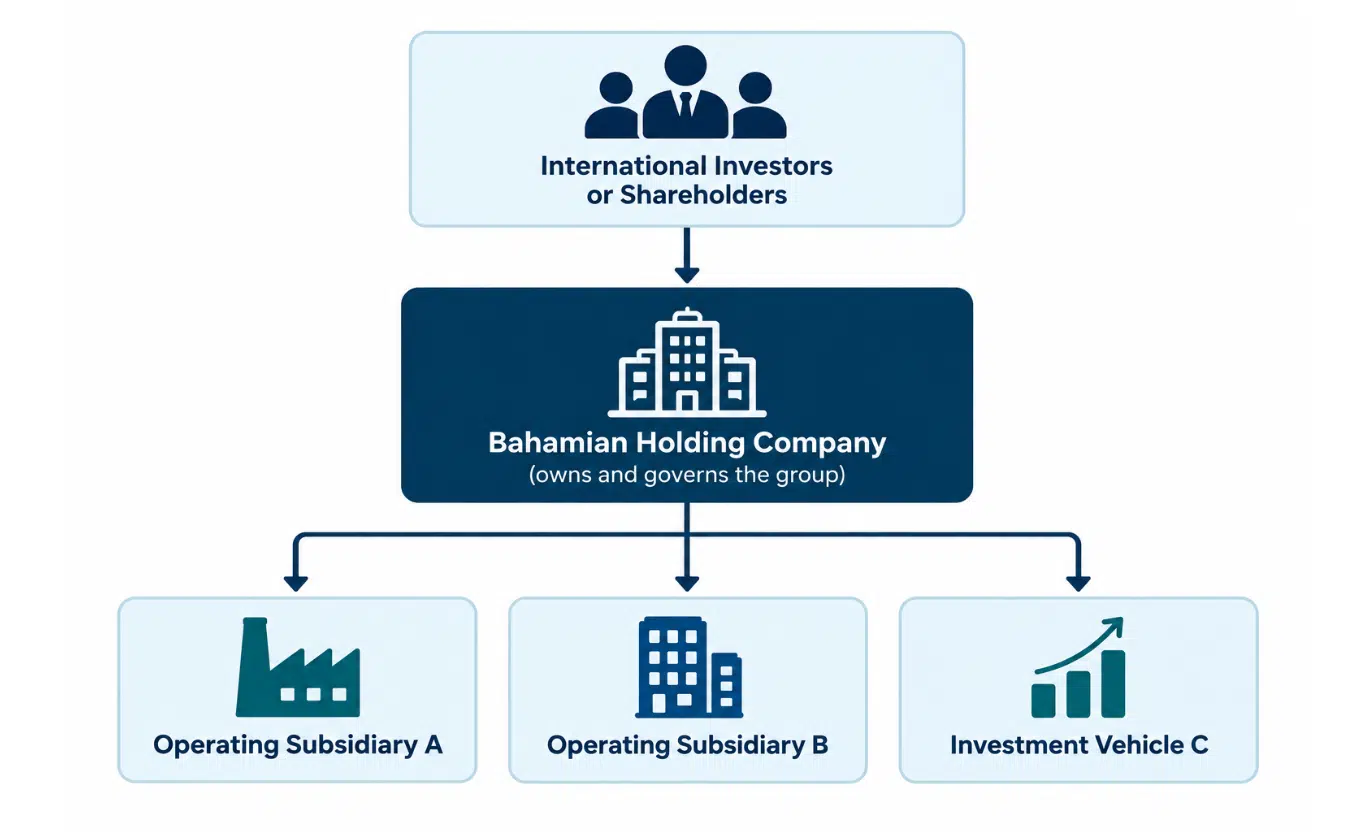
The holding company holds legal title to the shares of the subsidiaries. It does not typically conduct the subsidiaries’ business directly. It exercises shareholder rights, appoints directors, approves major transactions, and provides the ownership layer through which investors participate in the group’s value.
The holding company and each subsidiary are separate legal entities. Each owns its own assets and is responsible for its own liabilities. This separation is the foundation of many of the structural advantages a holding company provides, and also the source of several common misunderstandings about what those advantages actually deliver.
| Feature | Holding Company | Operating Company |
| Primary function | Owns shares in subsidiaries or assets | Conducts commercial activities |
| Day-to-day trading | Generally none | Core activity |
| Revenue sources | Dividends, capital gains, management fees | Revenue from operations |
| Liability profile | Generally limited to investments held | Exposed to operational and commercial risks |
| Management focus | Group governance, capital allocation, investor relations | Operations, customers, employees |
The distinction matters because governance, regulatory requirements, economic substance obligations, and compliance frameworks all differ between an entity that holds equity and one that actively trades.
The reasons are specific and commercial. They are not primarily about reducing tax or concealing ownership, and structuring primarily around those motivations creates legal and reputational risk rather than managing it.
A group operating in multiple jurisdictions may have different shareholders, management teams, and operating entities in each country. Without a common holding vehicle, governance, shareholder meetings, and investor participation must be organised separately for each subsidiary.
A holding company provides a single point of equity ownership for the group. Investors participate at the holding-company level. Decisions about group direction, capital allocation, and major transactions can be made through a single board rather than across multiple entities in different jurisdictions simultaneously.
Consider a Caribbean hospitality group operating hotels in four countries. A Bahamian holding company owning 100% of each operating entity gives the group’s investors a single shareholding representing their interest in the whole business, rather than four separate stakes in four separate companies, each with its own governance requirements.
A holding company structure can make acquisitions and divestments cleaner. Buying or selling an operating business through share transfers at the holding-company level may be more straightforward than transferring assets directly from operating entities, though the specific advantages in any particular transaction depend on the jurisdictions and structures involved.
Joint venture partners, private equity investors, and strategic acquirers are familiar with holding company structures and often prefer them because they provide a clear ownership layer that separates the governance of the group from the day-to-day management of individual businesses.
Separate corporate legal personality is the cornerstone of company law, established in Salomon v A Salomon & Co Ltd [1897] AC 22 and applied consistently since. An entity validly incorporated as a separate company owns its own assets, owes its own debts, and is generally responsible for its own liabilities. A claim against one subsidiary does not automatically extend to the holding company or to other subsidiaries.
This principle provides a rational basis for separating different business activities into different entities. A construction business, a property investment business, and a hospitality business within the same group have different risk profiles, different regulatory requirements, and different financing needs. Holding them in separate subsidiaries under a common holding company allows each to be managed according to its own characteristics.
The separation is not absolute. Personal guarantees by the holding company for a subsidiary’s obligations override separate legal personality for those debts. Insolvency brings directors’ conduct under scrutiny. Courts can look behind the corporate structure where it was used specifically to evade an existing legal obligation or where the separation was never genuinely observed in practice. Separate legal personality is the starting point, not a guarantee.
A holding company with clearly defined share classes, voting rights, and governance arrangements provides a practical vehicle for bringing together investors with different economic interests and different levels of participation in management.
Different share classes can give some investors economic rights without management participation, while others hold decision-making roles with defined economic returns. A shareholders’ agreement at the holding-company level can define how decisions are made, what rights investors have on exit, and how deadlocks are resolved. These arrangements are considerably cleaner to implement through a purpose-built holding vehicle than through an operating company also managing its daily business.
Our article on shareholder disputes in offshore companies illustrates what happens when corporate structures are established without adequate governance documentation. The holding company is only as effective as the agreements governing it.
For family-owned businesses, the holding company often forms one layer in a broader succession structure. A Bahamian holding company whose shares are held by a trust or foundation can provide the operational governance framework for a family business while the ownership structure above it provides for succession and long-term family governance.
These arrangements serve different legal functions: the company governs the business and holds the subsidiaries; the trust or foundation governs the ownership of the company and provides for succession. Our comparison of Bahamas foundation versus trust structures explains how these vehicles differ and which scenarios each serves.
A holding company at the apex of a corporate group can clarify reporting lines, define where major decisions are made, and provide a single point of accountability for the group’s investors and stakeholders. Board composition, financial reporting, internal audit, and risk management can be organised at the holding-company level, with subsidiary boards operating within delegated authority.
This structure is particularly useful as a business grows beyond the direct oversight of its founders. It creates a framework through which the group can be managed consistently, while allowing individual operating companies to retain responsibility for their own commercial activities.
The Bahamas offers a developed legal and professional infrastructure for international corporate structures. The jurisdiction has a mature corporate law framework built on common law foundations, experienced legal and financial services professionals, and a stable regulatory environment that international investors and their advisers are familiar with.
A Bahamian IBC incorporated under the International Business Companies Act is widely used for offshore holding structures in the region. IBCs have separate legal personality, can hold shares in subsidiaries in other jurisdictions, issue different classes of shares, and maintain corporate records through a licensed registered agent in The Bahamas.
Whether an IBC is appropriate for a particular holding structure depends on what the entity will do, who owns it, what economic substance obligations arise, and what business licence and compliance requirements apply. Our guide to Bahamas IBC vs LLC examines how different Bahamian corporate vehicles compare for holding and other purposes.
For some structures, particularly those involving local Bahamian operations or specific regulatory requirements, a company incorporated under the Companies Act may be more appropriate than an IBC. Entity selection depends on the proposed activities, ownership arrangements, and applicable regulatory framework. Our guide to choosing the right offshore company structure in The Bahamas addresses entity selection in detail and is the better reference for readers deciding between Bahamian corporate vehicles. This article focuses on what holding companies do and why businesses use them.
Incorporating a Bahamian holding company and authorising it to conduct intended activities are distinct steps. Where the holding company will have active business operations in The Bahamas, employ staff, acquire Bahamian real estate, or operate in a regulated sector, foreign investment approvals, business licences, and sector-specific regulatory authorisations may be required separately from and in addition to the incorporation itself.
Our guide to doing business in The Bahamas as a foreign investor covers the regulatory framework for foreign-controlled businesses, including the Bahamas Investment Authority and sector licensing requirements.
| Structure | Main purpose | Key consideration |
| Holding company | Owns shares in subsidiaries or assets | Governance, group structure, investor participation |
| Operating company | Conducts commercial activities | Operational liabilities, licensing, regulatory compliance |
| Joint venture company | Shared investment or commercial activity | Shareholder rights, governance, exit provisions |
| Trust | Holds property through trustees for beneficiaries | Trustee duties, fiduciary obligations, beneficiary rights |
| Foundation | Separate legal entity for specified purposes | Charter and governing documents, legal personality |
Holding companies and operating companies describe functions. An entity that primarily owns is a holding company; one that primarily trades is an operating company. The same entity can shift between these characterisations as its activities change. Trusts and foundations are different legal arrangements, not alternative holding company types. They can sit above a holding company as the ownership vehicle, but they serve different legal functions and are not interchangeable with a corporate holding structure.
This is where structure decisions are validated or undermined. Getting the commercial rationale right without addressing the legal and regulatory requirements produces a structure that may not survive scrutiny.
The directors of a Bahamian holding company owe duties to the company under Bahamian law, including the duty to act honestly and in good faith with a view to the best interests of the company, and to exercise the care, diligence, and skill of a reasonably prudent person in comparable circumstances. These obligations apply regardless of how the holding company is structured or who its shareholders are.
Governance failures at the holding-company level, including undisclosed conflicts of interest, self-dealing transactions between the holding company and related parties, and failure to maintain adequate corporate records, can produce personal liability for directors. Our article on director liability in The Bahamas explains these obligations and the circumstances in which personal exposure arises.
A holding company that nominally exists but has no functioning board, no documented decision-making, and no genuine separation between its affairs and those of its shareholders is not a properly governed entity. Board composition, shareholder agreements, decision-making thresholds, and reserved matters for shareholder approval should all be addressed in the holding company’s constitutional documents and governance framework.
Establishing an offshore holding company does not eliminate beneficial ownership disclosure or due diligence obligations. Bahamian law requires beneficial ownership information to be maintained and made available to relevant authorities. The registered agent carries responsibility for carrying out customer due diligence and maintaining current ownership records.
The holding company provides a legal ownership layer. It does not provide anonymity. Those two things are different, and confusing them is a significant compliance risk.
The Commercial Entities (Substance Requirements) Act 2023 (CESRA 2023) imposes obligations on all entities incorporated in The Bahamas, including holding companies.
Every entity must file an annual economic substance declaration through its registered agent within nine months of the financial year-end, regardless of its activities. This is the baseline obligation.
The definition of “holding business” as a relevant activity under CESRA 2023 creates a further distinction. A pure equity holding entity, meaning one that only holds equity participations and earns dividends and capital gains, is subject to reduced substance requirements: it must maintain adequate human resources and premises to hold and manage those equity participations and comply with its Bahamian filing and reporting obligations. Holding companies that also conduct other relevant activities, such as providing intra-group financing, managing intellectual property, or acting as a group headquarters, face full economic substance requirements for those activities.
The applicable test for any particular entity must be verified against current CESRA 2023 guidance. Economic substance filing obligations and current annual declaration requirements are detailed through the Bahamas Ministry of Finance economic substance and AEOI portal.
Ongoing anti-money laundering and know-your-customer obligations apply throughout the life of the entity. These include maintaining current identification and due diligence records for beneficial owners, directors, and shareholders; applying source-of-funds checks appropriate to the risk profile of the entity; and reporting obligations under the Financial Transactions Reporting Act.
These are not one-time requirements satisfied at incorporation. They require ongoing attention whenever ownership or control changes, when new shareholders or directors are added, and when the entity’s activities change materially.
A Bahamian holding company owned by US shareholders, holding subsidiaries in the UK and Canada, and earning dividends from businesses operating across several countries connects to the tax and reporting systems of multiple jurisdictions simultaneously.
The Bahamas does not impose corporate income tax, capital gains tax, or withholding tax on dividends. But the tax treatment of the Bahamian holding company from the perspective of its shareholders’ home jurisdictions is a separate question, and the answer varies considerably depending on where those shareholders are resident, whether relevant controlled foreign corporation rules apply, what treaty arrangements exist, and what the holding company actually does.
Holding company tax benefits, where they legitimately exist, arise from specific provisions of applicable domestic law and double-tax treaties. They cannot be assumed, and they cannot be created simply by incorporating an entity in a low-tax jurisdiction. Specialist tax advice in every jurisdiction where shareholders, subsidiaries, and assets are located is a necessary component of any international holding company structure.
Failing to document shareholder rights and decision-making. A holding company with two or more shareholders and no shareholders’ agreement, no governance provisions addressing deadlock, and no defined procedures for major decisions is a dispute waiting to happen.
Assuming the holding company provides absolute asset protection. As discussed, the protection is real but conditional. Guarantees, insolvency, and genuine corporate separation failures can all erode it.
Ignoring beneficial ownership, economic substance, and ongoing compliance. These are not formation-stage obligations that can be addressed once and set aside. They require ongoing attention, annual filings, and updates whenever the entity’s ownership, activities, or circumstances change.
Failing to consider acquisitions, exits, disputes, and succession. A structure designed for the current configuration of the business should also work for what the business might look like in five or ten years. Tag-along and drag-along rights, pre-emption provisions, and succession arrangements at the holding-company level are considerably easier to put in place at formation than to negotiate into an existing structure after a dispute has arisen.
An international holding company structure is most clearly useful for groups with genuine operational complexity: multiple subsidiaries in different jurisdictions, multiple investors with different economic interests, businesses in different sectors that benefit from risk separation, or owners planning acquisitions, investment rounds, or future exits.
It adds unnecessary complexity for a single-entity business with straightforward ownership, a start-up that has not yet demonstrated the commercial scale to justify the compliance and governance overhead, or a family investment that would be better served by a simpler structure at this stage.
The appropriate structure depends on what the business actually needs, not on what sounds more sophisticated.
The practical steps are covered in our dedicated guides. At a high level, the process involves defining the intended business and ownership objectives before selecting a corporate vehicle, confirming any foreign investment approvals or regulatory requirements, preparing constitutional documents and shareholder agreements that reflect the governance framework, completing incorporation and required due diligence, legally transferring the intended shareholdings or assets into the entity, and establishing ongoing compliance procedures.
The order matters. Defining purpose and legal requirements before incorporation produces a structure designed for the intended use. Incorporating first and resolving the details later produces a structure that may need to be restructured almost immediately at additional cost.
Our guide to incorporating a company in The Bahamas covers the formation process in detail.
Our corporate and commercial practice advises international businesses, investors, and family offices on Bahamian corporate structuring, holding company formation, shareholder agreements, corporate governance, commercial transactions, and restructuring. Where holding company structures connect to trust or wealth structuring objectives, our trust and private client practice works alongside the corporate advisory function.
Where holding company structures become the subject of disputes, our commercial and trust litigation practice handles the full range of shareholder, director, and corporate disputes that arise when governance frameworks break down.
If you are considering establishing, restructuring, or reviewing a Bahamian holding company, contact the ParrisWhittaker team to discuss your specific objectives.
Offshore holding company structures serve genuine commercial purposes for international businesses managing multiple subsidiaries, multiple investors, and complex governance requirements. The Bahamas offers a developed legal and professional infrastructure that makes it a credible choice for groups with Caribbean and broader international operations.
The structure’s value depends on how it is designed, how it is governed, and whether it is maintained in compliance with the applicable legal and regulatory framework. A holding company that is properly incorporated, governed, and documented provides meaningful structural benefits. One that exists on paper without genuine governance, compliance, or separation from its shareholders delivers considerably less, and carries meaningful legal and regulatory risk.
Getting the structure right from the outset, with qualified legal advice in all relevant jurisdictions, is the foundation of a holding company arrangement that continues to deliver over the long term.
What is an offshore holding company?
An offshore holding company is a company established in a jurisdiction outside its owners’ home country whose primary function is to own shares or other interests in operating businesses or assets, rather than conducting day-to-day trading activity. It provides a common ownership layer for a corporate group and facilitates investor participation and group governance.
What are the benefits of an offshore holding company?
The principal benefits are consolidated group ownership through a single entity, cleaner governance and investor participation structures, separation of different business activities and their associated liabilities through subsidiary entities, and flexibility for acquisitions, joint ventures, and investor exits. The benefits depend on how the structure is designed and operated.
Can a foreign investor establish a holding company in The Bahamas?
Generally yes. Foreign investors can establish International Business Companies or Companies Act companies in The Bahamas. Where the holding company will have active local operations, foreign investment approvals or business licences may also be required depending on the sector and ownership structure.
What is the difference between an offshore holding company and an IBC?
“Holding company” describes the function an entity performs: it holds equity interests in other entities or assets. An IBC is a specific statutory corporate vehicle in The Bahamas, incorporated under the International Business Companies Act. An IBC can be used as a holding vehicle, but the holding company function is not limited to the IBC structure.
Can an offshore holding company own multiple subsidiaries?
Yes. A holding company can own shares in any number of subsidiaries, across different jurisdictions and sectors. The governance arrangements for each subsidiary, and the relationship between the holding company and its subsidiaries, should be defined in the constitutional documents and any associated shareholder agreements.
Does an offshore holding company protect assets from lawsuits?
Separate legal personality means that a subsidiary’s liabilities do not automatically extend to the holding company or to other subsidiaries. But the protection is conditional, not absolute. Personal guarantees, insolvency situations, fraudulent transfer rules, and failure to maintain genuine corporate separation can all reduce the benefit.
Do Bahamas holding companies have economic substance requirements?
Yes. All entities incorporated in The Bahamas, including holding companies, must file annual economic substance declarations under CESRA 2023. A pure equity holding entity, one that only holds equity participations and earns dividends and capital gains, is subject to reduced substance requirements involving adequate human resources and premises to hold and manage those participations. Holding companies conducting other relevant activities face full economic substance requirements for those activities.
Can a trust own a Bahamas holding company?
Yes. A trust holding shares in a Bahamian holding company is a common structure in international family wealth planning. The trust provides the succession planning and long-term ownership framework; the company provides the operational and corporate governance structure for the underlying businesses or assets. Each performs a different legal function.

CLOSE X
